Introduction
Reading is an important skill that helps us learn new information, develop vocabulary, and understand the world around us. However, reading words on a page does not always mean we understand their meaning. Many students can read a paragraph fluently but struggle to explain its main idea, remember important details, or answer questions about what they have read. This is where reading comprehension skills become essential.
In my opinion, good reading comprehension is not only important for students but also useful for people of all ages. Whether we are reading textbooks, articles, instructions, stories, or online resources, understanding the message makes reading more valuable. Strong comprehension skills can also support academic performance, communication, critical thinking, and lifelong learning.
The good news is that reading comprehension can improve with regular practice and the right techniques. By learning how to identify main ideas, build vocabulary, ask questions, and summarize information, readers can become more confident and effective.
In this article, I will explain practical ways to improve reading comprehension skills and develop better reading habits for everyday learning.
1. Read Regularly Every Day
One of the simplest ways to improve reading comprehension is to make reading a regular habit. Like other skills, reading becomes easier when we practice consistently.
You do not need to read for several hours every day. Starting with 15 to 20 minutes of focused reading can be a useful approach. Choose material that matches your current reading level and interests, such as short stories, educational articles, books, or news reports.
Regular reading helps you become familiar with sentence structures, different writing styles, and new vocabulary. Over time, you may find it easier to understand longer passages and follow complicated explanations.
Try to select materials that are interesting but still offer a little challenge. If the text is too easy, you may not learn much new information. If it is too difficult, you may become frustrated and lose motivation.
Consistency matters more than reading a large amount once in a while. A short daily reading session can help build a lasting habit and improve comprehension gradually.
2. Identify the Main Idea of a Passage
Understanding the main idea is one of the most important reading comprehension skills. The main idea explains what a paragraph, article, or chapter is primarily about.
For example, if a passage describes how regular exercise supports physical fitness, improves mood, and increases energy, the main idea may be that exercise offers several health benefits.
Supporting details provide additional information, examples, facts, or explanations that help develop the main idea.
To practice this skill, read a paragraph and ask yourself, “What is the writer mainly trying to explain?” Try answering in one sentence without copying the entire paragraph.
You can also give each paragraph a short heading. This encourages you to focus on the central message instead of remembering every individual sentence.
When reading longer texts, identify the main idea of each section and consider how the sections connect. This makes it easier to understand the overall message.
3. Improve Your Vocabulary
Vocabulary plays a major role in reading comprehension. If you frequently encounter words you do not understand, it can become difficult to follow the writer’s message.
A practical way to improve vocabulary is to keep a notebook of unfamiliar words. Whenever you find a useful word, write it down with its meaning and an example sentence.
For example, if you learn the word “essential,” you might write, “Regular practice is essential for improving reading skills.”
However, avoid stopping to look up every unfamiliar word. Sometimes, you can understand its general meaning from the surrounding sentences. This ability is called using context clues.
For example, consider the sentence: “After walking for several hours, the hikers were exhausted and needed to rest.” Even if you do not know the word “exhausted,” the rest of the sentence suggests that the hikers were extremely tired.
Use a dictionary when a word is important to understanding the passage or appears repeatedly. Review your vocabulary notebook regularly and try using new words in your own writing and conversations.
4. Ask Questions While Reading
Active reading means interacting with the text rather than simply moving your eyes across the page. Asking questions encourages you to think about the information and check whether you understand it.
Before reading, look at the title and consider what the text might explain. While reading, ask questions such as:
- What is the main point of this section?
- Why is this information important?
- What evidence supports the writer’s explanation?
- How does this idea connect with what I already know?
- What might happen next in the story or discussion?
After finishing a section, try answering your questions without looking back immediately.
This technique is especially helpful when reading textbooks, educational articles, and academic materials. It encourages you to pay attention to important information and notice when something is unclear.
You can also write questions in the margins of your notes or use them to prepare for classroom discussions.
The more actively you engage with a passage, the easier it becomes to understand and remember its message.
5. Summarize What You Read
Summarizing is a powerful way to check reading comprehension. It requires you to identify the most important information and explain it in your own words.
After reading a paragraph, section, or chapter, pause and write a short summary. Include the main idea and the most important supporting details, but leave out unnecessary examples and repeated information.
For instance, after reading an article about healthy study habits, your summary might explain that regular revision, focused study sessions, and adequate sleep can support learning.
If you cannot summarize a passage clearly, you may need to review it and identify the parts that are confusing.
Try to avoid copying sentences directly from the original text. Using your own words helps you process the information and recognize whether you have understood it.
Summarizing is useful for students preparing for examinations because it creates concise revision notes. It can also help readers remember information from reports, books, and online articles.
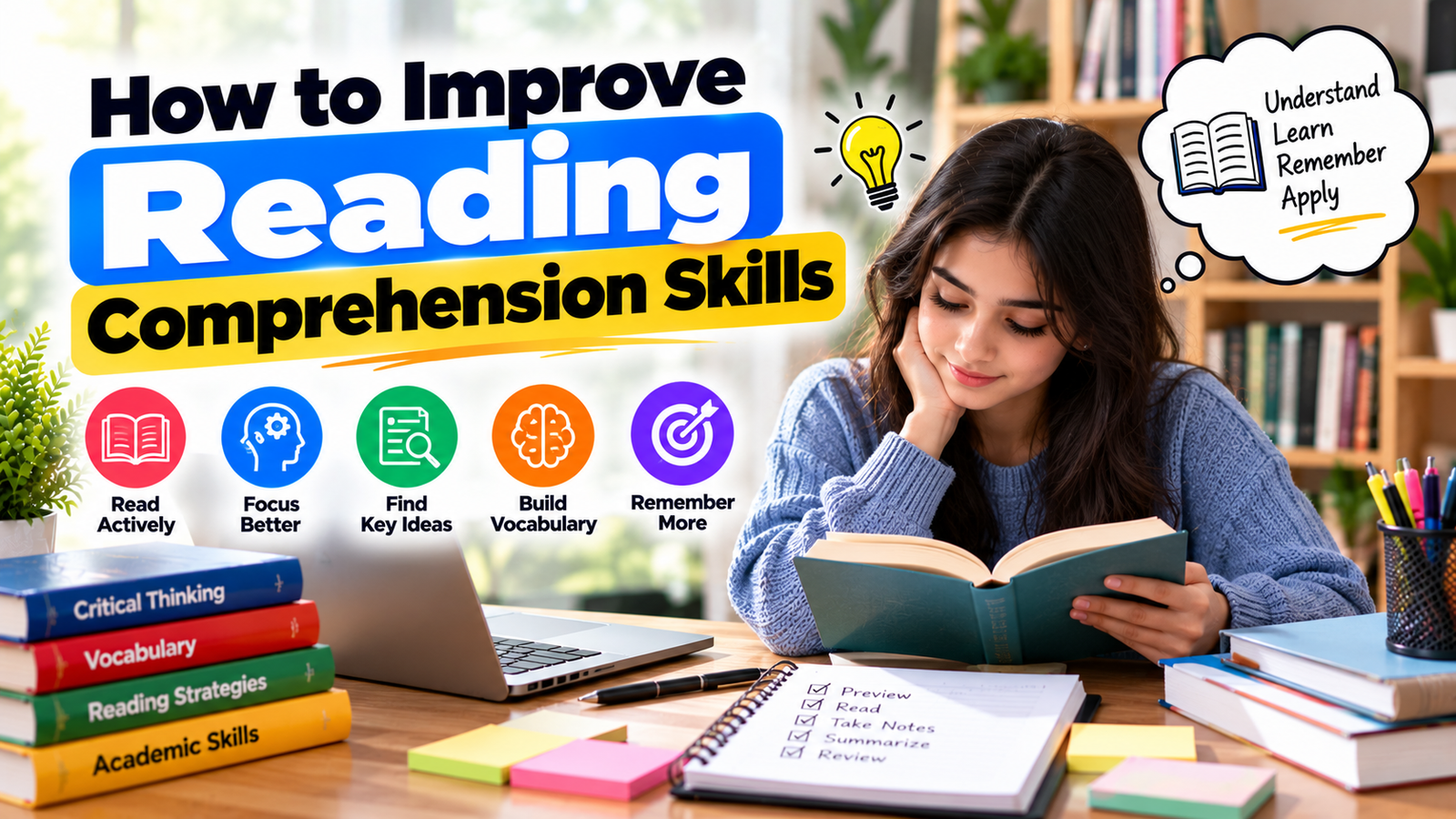
6. Use the Preview, Read, and Review Method
A simple reading routine can make difficult material easier to understand. One useful approach is to preview the text, read it carefully, and then review the main points.
Preview: Before reading, examine the title, headings, subheadings, images, captions, and introductory paragraph. These elements provide clues about the topic and help you prepare for the information.
Read: Read the passage with attention. Look for the main idea, supporting details, unfamiliar terms, and connections between paragraphs. Slow down when a sentence contains an important or complicated concept.
Review: After reading, summarize the content, answer a few questions, or explain the key ideas aloud.
This method is especially useful for textbooks and other long reading materials. Previewing gives you a general understanding of the structure, while reviewing helps you identify what you have learned.
You can adjust the method depending on the type of material. A short news article may need only a brief preview, while a difficult academic chapter may require more careful review.
7. Read at a Comfortable Pace
Reading speed is often discussed as if faster reading always means better reading. In reality, comprehension is more important than speed.
If you read too quickly, you may miss important details, misunderstand unfamiliar words, or fail to recognize relationships between ideas. On the other hand, reading every sentence extremely slowly can make it difficult to maintain the overall meaning.
The best approach is to adjust your reading speed to the difficulty of the material.
For familiar and straightforward content, you may be able to read at a normal pace. For technical explanations, complex arguments, or unfamiliar subjects, slow down and reread important sections when necessary.
Pause after a difficult paragraph and explain its meaning in simple language. If you cannot do this, read the paragraph again and look for the main point.
Avoid focusing too much on how many pages you finish. A smaller amount of material understood properly is often more valuable than several pages read without understanding.
8. Learn to Recognize Supporting Details
Supporting details help explain, prove, or illustrate the main idea. They may include examples, statistics, explanations, descriptions, or evidence.
Learning to recognize these details can improve your understanding of both academic and everyday texts.
For example, a paragraph might state that exercise can improve physical fitness. It may then describe how walking, cycling, and swimming help people stay active. The activities are examples that support the main point.
As you read, ask yourself which information is essential to the writer’s argument and which information simply provides an example.
Pay attention to signal words such as “because,” “for example,” “therefore,” “however,” and “in contrast.” These words can indicate relationships between ideas.
Understanding how supporting details work helps you follow explanations more accurately. It is particularly useful when reading essays, textbooks, research summaries, and persuasive articles.
9. Practice Making Inferences
Reading comprehension involves understanding both what a writer says directly and what the writer implies.
An inference is a conclusion based on available information and reasonable thinking.
For example, imagine reading this sentence: “Sara looked at the dark clouds, picked up her umbrella, and hurried toward the bus stop.” The passage does not directly say that Sara expects rain, but the details suggest that she may be preparing for it.
To practice making inferences, pay attention to clues in the text. Consider what you already know and use the information provided by the writer to reach a reasonable conclusion.
However, it is important to distinguish between a supported inference and a personal guess. Your conclusion should be based on evidence from the passage rather than assumptions that the text does not support.
This skill is valuable when reading literature, understanding characters, analyzing arguments, and interpreting information in everyday situations.
10. Reduce Distractions While Reading
Your reading environment can affect how well you understand a text. If you repeatedly check your phone, respond to messages, or switch between browser tabs, you may lose track of the information.
Choose a comfortable place where you can focus. Put unnecessary devices aside, silence nonessential notifications, and keep your reading materials nearby.
If you are studying online, close unrelated tabs and avoid opening other websites during focused reading sessions.
You can also set a specific reading goal. For example, decide to read one chapter and summarize its main ideas before taking a break.
If your attention begins to wander, pause for a moment and return to the last section you clearly understood. Reread it if necessary.
Short, focused reading sessions may be more productive than long sessions filled with interruptions.
11. Choose Reading Materials That Match Your Level
Selecting suitable reading material can make the learning process more enjoyable and effective.
If you are a beginner, start with short stories, simple articles, or books written in clear language. As your vocabulary and comprehension improve, gradually move toward longer and more challenging texts.
Students should also read material related to their academic subjects. This helps them become familiar with subject specific vocabulary and the way information is explained in different disciplines.
For example, science texts often include technical terms and explanations of processes, while history texts may focus on events, causes