
Introduction
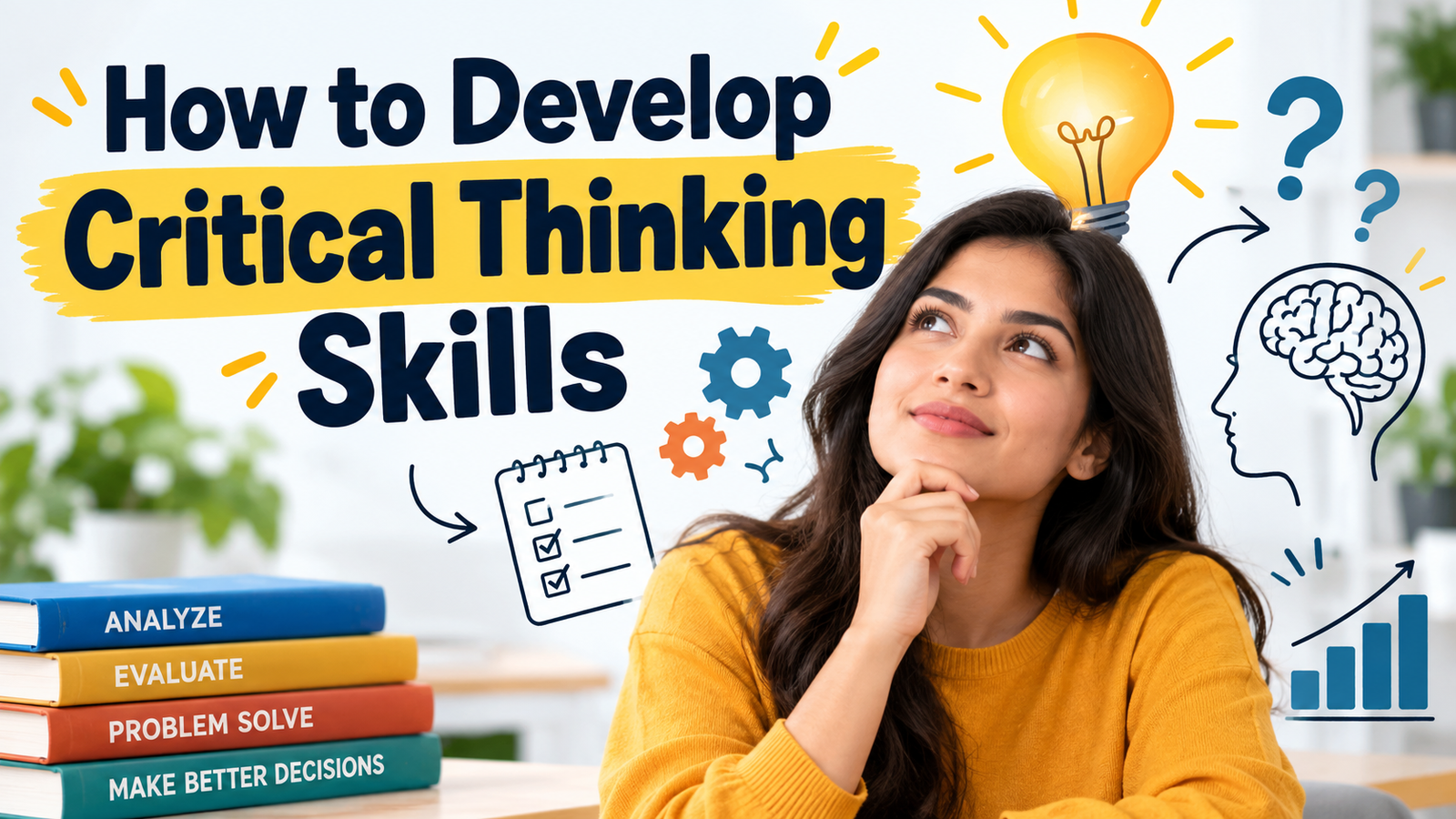
Critical thinking is one of the most important skills a person can develop for education, work, and everyday life. It helps us understand information, solve problems, evaluate different opinions, and make better decisions. Instead of accepting everything we hear or read, critical thinking encourages us to ask questions, examine evidence, and reach conclusions based on careful reasoning.
In my opinion, critical thinking is not something that only intelligent people can do naturally. It is a skill that anyone can improve through regular practice, curiosity, and a willingness to learn. Students can use critical thinking to understand difficult subjects, professionals can apply it to workplace challenges, and individuals can use it to make more thoughtful decisions in daily life.
Developing critical thinking skills takes time, but even small changes in the way we read, study, discuss ideas, and solve problems can make a meaningful difference. In this article, I will explain practical ways to improve critical thinking skills and use them more effectively in everyday situations.
1. Learn to Ask Better Questions
One of the easiest ways to develop critical thinking skills is to ask meaningful questions. Instead of accepting information immediately, take a moment to understand what is being said and why it might be true.
For example, when reading an article, you can ask yourself who created it, what evidence supports its main claims, and whether other explanations are possible.
Questions such as these encourage you to look beyond the surface and understand a topic more deeply.
Here are some useful questions to practice:
- What is the main idea?
- What evidence supports this claim?
- Is the information based on facts or opinions?
- Are there other possible explanations?
- What information might be missing?
- What conclusion can I reasonably draw from the available evidence?
These questions are useful in classrooms, workplace discussions, online research, and everyday conversations.
The goal is not to question everything without reason. It is to develop the habit of examining important information before deciding whether to accept it.
2. Separate Facts From Opinions
Critical thinking requires the ability to distinguish facts from opinions. A fact is a statement that can be checked using reliable evidence, while an opinion expresses a person’s belief, judgment, or preference.
For example, the statement “Water freezes at approximately zero degrees Celsius under standard atmospheric pressure” describes a measurable scientific fact. The statement “Science is the most interesting school subject” expresses a personal opinion.
Both facts and opinions can be useful, but they serve different purposes.
When reading a news story, social media post, textbook, or online discussion, try to identify which statements can be verified and which reflect someone’s personal viewpoint.
You should also remember that a statement presented confidently is not automatically true. Opinions may be supported by evidence, while factual claims may be incorrect or misleading.
Learning to make this distinction helps you evaluate information more carefully and avoid forming conclusions based only on emotions or personal preferences.
3. Develop Strong Research Skills
Good critical thinking depends on reliable information. If you make decisions using inaccurate or incomplete information, your conclusions may also be unreliable.
Developing research skills helps you find trustworthy information, compare sources, and understand different perspectives.
When researching a topic, begin with a clear question. Then look for information from credible sources, such as educational institutions, scientific publications, official reports, and recognized subject experts.
Do not depend entirely on a single website or social media post. Compare information from several independent sources when the topic is important.
Pay attention to the publication date, the author’s qualifications, the evidence presented, and whether the source explains its limitations.
For example, if you are researching the benefits of online learning, look for educational studies, compare their findings, and consider factors such as student age, learning environment, and access to technology.
This approach helps you develop conclusions based on evidence rather than assumptions.
4. Practice Active Reading
Reading is an excellent way to improve critical thinking, but simply moving your eyes across a page may not lead to deep understanding. Active reading involves thinking about the material while you read.
Start by identifying the main argument of the text. Then examine the evidence used to support it.
Ask yourself whether the examples are relevant, whether the reasoning is logical, and whether the author has considered alternative viewpoints.
You can also write short notes in your own words. Summarizing an argument helps you determine whether you understand it correctly.
For example, after reading a chapter in a textbook, close the book and explain its main ideas without looking at the original text. Then review the chapter to identify anything important that you missed.
You can apply the same technique to articles, reports, essays, and other learning materials.
Regular active reading improves comprehension and encourages you to evaluate ideas instead of memorizing information without understanding it.
5. Consider Different Perspectives
A common mistake in decision making is assuming that our first interpretation must be correct. Critical thinkers understand that a situation can often be viewed from several different perspectives.
When examining a problem, try to understand how other people might interpret the same situation. Their experiences, knowledge, goals, and circumstances may influence their conclusions.
For example, students may have different opinions about online education. One student might appreciate the flexibility, while another may struggle with distractions or limited internet access.
Instead of deciding that one student must be wrong, consider the circumstances that explain their different experiences.
You do not have to agree with every viewpoint. The purpose is to understand the reasoning behind different opinions and evaluate which arguments have the strongest support.
This habit can improve communication, reduce misunderstandings, and help you make more balanced decisions.
6. Improve Your Problem Solving Skills
Critical thinking and problem solving are closely connected. When you face a challenge, critical thinking helps you identify the real problem, consider possible solutions, and evaluate their likely results.
A useful approach is to divide the process into manageable steps.
First, define the problem clearly. Avoid focusing only on the symptoms if the underlying cause is different.
Second, collect relevant information. Identify what you know, what you do not know, and what additional information might help.
Third, develop several possible solutions. Looking at multiple options prevents you from accepting the first idea without examining alternatives.
Fourth, compare the advantages, disadvantages, costs, and risks of each option.
Finally, choose a reasonable solution, test it when possible, and evaluate the outcome.
For example, if you are struggling to complete assignments on time, the problem may not simply be a lack of study hours. You might need to improve time management, reduce distractions, divide assignments into smaller tasks, or ask your teacher for clarification.
By identifying the cause before choosing a solution, you can address problems more effectively.
7. Recognize Common Thinking Errors
Everyone makes mistakes in reasoning. Learning to recognize common thinking errors can help you evaluate your own ideas more objectively.
One common error is confirmation bias. This happens when people pay more attention to information that supports their existing beliefs while ignoring evidence that challenges them.
Another is jumping to conclusions. This occurs when someone makes a judgment before gathering enough information.
Overgeneralization is another problem. For example, if one study method does not work for you, it does not necessarily mean that all study methods are ineffective.
Emotional reasoning can also affect judgment. Feeling strongly about a claim does not automatically make it true.
To reduce these errors, pause before making important decisions. Look for evidence that might challenge your assumptions, consider alternative explanations, and ask whether your conclusion follows logically from the available facts.
You will not avoid every thinking error, but recognizing them can improve the quality of your decisions over time.
8. Use Logic When Evaluating Arguments
An argument is a set of statements intended to support a conclusion. Critical thinking involves examining whether the reasons offered actually support that conclusion.
For example, someone might say that a student who studies for many hours always earns higher marks. However, the number of study hours alone does not prove that a student will perform well. Understanding, practice, sleep, teaching quality, and other factors can also influence results.
This example shows why it is important to examine the connection between evidence and conclusions.
When evaluating an argument, identify the main claim, list the reasons supporting it, and check whether the evidence is relevant and sufficient.
Look for unsupported assumptions, contradictions, and conclusions that go beyond what the evidence demonstrates.
You should also avoid judging an argument only by whether you agree with its conclusion. A conclusion that matches your opinion can still be supported by weak reasoning.
Strong critical thinking means evaluating the quality of the reasoning, even when the subject is personally important to you.
9. Improve Your Decision Making Skills
Everyday life involves many decisions, from choosing a course of study to managing money or planning your schedule. Critical thinking helps you consider the available options and make decisions more carefully.
Begin by identifying your goal. A decision cannot be evaluated properly unless you understand what you are trying to achieve.
Next, gather the information needed to compare your options. Consider the benefits, limitations, costs, risks, and possible long term consequences.
For example, when choosing a course, you might compare the subjects taught, learning opportunities, career options, fees, and your personal interests.
Avoid making important decisions entirely because of pressure from other people or because an option seems popular.
It can also be useful to establish a deadline for making the decision. Some choices require careful research, but spending too much time comparing minor details can become unproductive.
The aim is to make a reasonable decision using the best available information, while accepting that some uncertainty may remain.
10. Discuss Ideas With Other People
Meaningful discussions can help you improve critical thinking by exposing you to different arguments and ways of understanding a topic.
Choose a subject you find interesting and discuss it with classmates, teachers, friends, or colleagues. Ask questions, explain your reasoning, and listen carefully to the other person’s response.
Instead of trying to win every disagreement, focus on understanding the issue.
If someone challenges your opinion, consider whether their argument reveals a weakness in your reasoning or provides information you had not considered.
You can also practice summarizing another person’s argument before responding. This helps ensure that you understand their point rather than responding to an inaccurate interpretation.
Respectful discussions teach you to support your ideas with evidence, communicate clearly, and change your mind when stronger information becomes available.
Being willing to revise your opinion is not a sign of weakness. It is an important part of intellectual growth.
11. Keep Learning and Stay Curious
Curiosity encourages you to explore unfamiliar subjects and look for explanations. This habit can strengthen critical thinking because it motivates you to investigate questions instead of accepting simple answers without examination.
Read books, explore educational resources, learn new skills, and ask questions about topics you do not understand.
Try studying subjects outside your usual interests. For example, a student who primarily studies business might explore basic psychology or science to understand different ways of approaching problems.
Learning from varied subjects can help you recognize connections between ideas and develop a broader understanding of the world.
However, collecting information is only one part of learning. You should also reflect on what you learn, evaluate its reliability, and consider how it relates to existing knowledge.
Make curiosity a regular habit rather than something you practice only when preparing for an examination.
12. Practice Critical Thinking Every Day
You do not need special equipment or a complicated course to begin improving critical thinking skills. Everyday activities provide many opportunities to practice.
You can start by reviewing a decision you made during the day and asking whether you considered all the important information.
When you read a news article, identify its main claim and examine the evidence.
When solving a problem, write down at least two possible solutions before selecting one.
When learning a new topic, summarize it in your own words and identify questions that remain unanswered.
You can also keep a short reflection journal. Write about a decision, the evidence you considered, the options you examined, and what you learned from the result.
These activities encourage you to become more aware of your thinking habits.
Consistency matters more than complexity. Practicing for a few minutes each day can gradually help you become more thoughtful and systematic in the way you approach information.
Conclusion
Developing critical thinking skills is an ongoing process that requires curiosity, patience, and regular practice. By asking better questions, separating facts from opinions, researching reliable information, and considering different perspectives, you can improve your ability to understand complicated issues.
Problem solving, logical reasoning, active reading, and thoughtful decision making are also important parts of critical thinking. These skills help students perform better academically and allow individuals to make more informed choices in everyday life.
In my opinion, one of the most valuable habits is learning to question your own assumptions. It is easy to search for information that supports what we already believe, but real improvement comes from examining evidence fairly and remaining open to new ideas.
Start with simple daily activities, such as analyzing an article, solving a problem, or reflecting on a decision. Over time, these small habits can help you become a more independent learner, a clearer communicator, and a more confident problem solver.