
Introduction
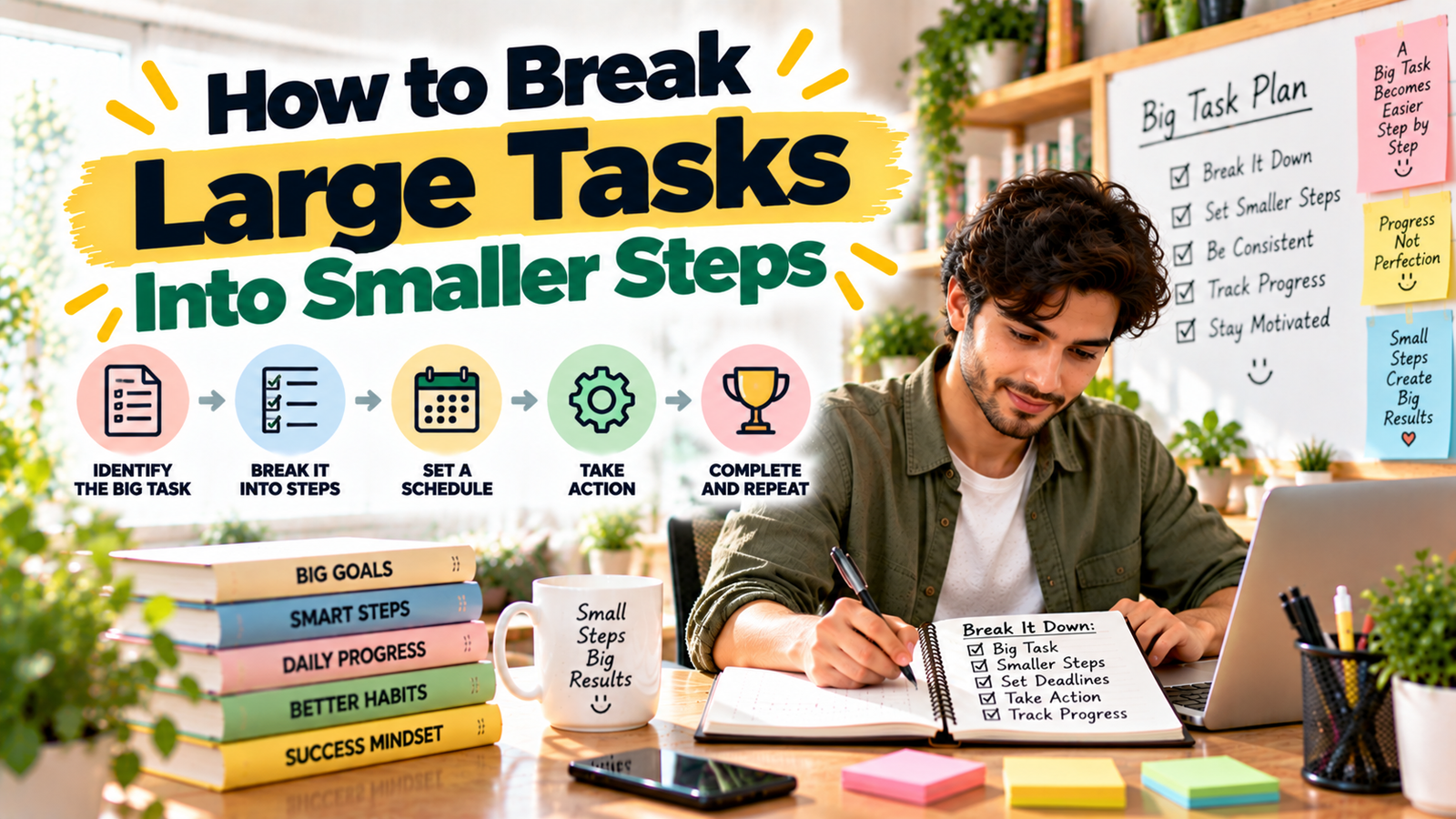
Sometimes, a task can feel so big that we do not know where to begin. Whether it is completing a work project, preparing for an exam, organizing the home, writing an article, or achieving a personal goal, looking at everything we need to do at once can create unnecessary stress. I believe one of the simplest ways to handle this problem is to break large tasks into smaller, manageable steps.
When I look at a large task as one big responsibility, it can seem difficult to finish. However, when I divide it into smaller actions, the process becomes clearer and easier to manage. Instead of worrying about the entire project, I can focus on completing one step at a time.
Learning how to break large tasks into smaller steps can improve productivity, time management, organization, and motivation. It also helps us make steady progress without feeling overwhelmed. In this guide, I will explain practical ways to divide large tasks into smaller steps and make everyday work easier to handle.
Why Is It Important to Break Large Tasks Into Smaller Steps?
Large tasks often require several different activities, decisions, and resources. When everything seems connected, it can be difficult to identify the first action. This uncertainty sometimes leads to procrastination, which means delaying work even when we know it needs to be completed.
Breaking a large task into smaller steps helps solve this problem by making the process more organized.
For example, imagine that you want to start a blog. Thinking about the entire project may involve choosing a niche, purchasing a domain, setting up a website, writing content, creating images, and learning about search engine optimization.
Instead of trying to handle everything at once, you can divide the project into separate stages. First, choose your topic. Next, select a domain name. After that, set up the website and begin preparing your content.
Each completed step brings you closer to the final goal.
In my view, the main benefit of this approach is that it replaces confusion with clarity. You know what needs to be done, where to begin, and what action should come next.
1. Define Your Main Goal Clearly
The first step in managing a large task is to understand exactly what you want to accomplish. If your goal is unclear, it becomes difficult to decide which actions are necessary.
Start by writing down your main objective in a simple sentence. Try to make it specific enough that you can recognize when the task is complete.
For example, instead of writing “I want to improve my studies,” you could write “I want to complete my science revision and practice questions before Friday.”
The second goal gives you a clearer direction because it identifies the work and the deadline.
A clearly defined goal also helps you avoid spending time on activities that do not contribute to the final result.
Before beginning any large task, ask yourself three questions:
- What exactly do I want to complete?
- Why is this task important?
- What will the finished result look like?
These questions help you understand the purpose of your work and make it easier to plan the next steps.
2. Divide the Task Into Major Sections
Once you have defined your main goal, divide it into several major sections. These sections represent the main stages required to complete the project.
For example, if you want to write a detailed article, the major sections might include researching the topic, preparing an outline, writing the introduction, developing the main content, editing the article, and publishing it.
Each section represents a different part of the overall process.
This method works well because it allows you to understand the structure of a task before you begin working on individual details.
Consider another example. If you want to organize your home, you could divide the work into cleaning the kitchen, organizing the bedroom, arranging the living room, and sorting storage areas.
You do not need to complete the entire home in one day. You can work on one section at a time according to your available time and energy.
I find this approach useful because it makes large responsibilities feel more realistic and gives each work session a clear purpose.
3. Turn Each Section Into Small Actions
After identifying the major sections, break each section into smaller actions that are easy to understand and complete.
For example, the section “organize the bedroom” could include collecting dirty clothes, arranging clean clothes, clearing the desk, organizing books, and putting unnecessary items away.
These actions are more manageable than the general instruction to organize an entire bedroom.
A useful rule is to make each action specific. Instead of writing “work on the project,” write “collect three useful sources” or “prepare the first section of the report.”
Specific actions reduce the amount of thinking required before you begin.
If a step still feels difficult, divide it again until you have an action that you can reasonably start without confusion.
However, avoid making the plan unnecessarily complicated. The purpose of breaking tasks into smaller steps is to simplify your work, not to create a long list that becomes another burden.
4. Prioritize the Most Important Steps
Not every step has the same level of importance. Some actions must be completed before others can begin, while some can wait until later.
After creating your task list, identify which steps are most important and which have approaching deadlines.
For example, if you are preparing a presentation for tomorrow, collecting the required information and preparing the main slides should usually come before choosing decorative colors or adjusting minor design details.
This does not mean that small details are unimportant. It simply means that essential work should receive attention first.
You can organize your tasks into three groups:
High priority: Actions that are essential or urgent.
Medium priority: Actions that support the main goal but are not immediately urgent.
Low priority: Optional improvements that can be completed after the important work.
Prioritization helps you use your time more effectively. It also reduces the risk of spending too much time on easy but unimportant activities while essential work remains unfinished.
5. Estimate How Much Time Each Step Requires
Time management becomes easier when you have a reasonable idea of how long each action might take.
When planning a large task, estimate the time required for every smaller step. Your estimates do not need to be perfect. They simply need to help you create a realistic schedule.
For example, you might plan to spend 20 minutes gathering information, 30 minutes preparing an outline, and 45 minutes writing an initial draft.
If a task requires more time than expected, adjust your schedule instead of assuming that your entire plan has failed.
It is also helpful to include short breaks and extra time for unexpected problems.
One common mistake is planning every minute of the day without allowing any flexibility. In real life, interruptions happen, and some activities take longer than expected.
A realistic schedule should support your progress rather than create additional pressure.
6. Set Small and Achievable Deadlines
Deadlines can help you maintain focus, especially when a project will take several days or weeks to complete.
Instead of setting only one deadline for the entire project, establish smaller deadlines for individual stages.
For example, if you need to prepare a research report within one week, you might aim to finish your research on Monday, complete the outline on Tuesday, write the first draft by Thursday, and review the report on Friday.
These smaller deadlines help you track your progress and identify delays before they become serious problems.
When setting deadlines, consider your other responsibilities, working speed, and available resources.
Avoid setting unrealistic targets simply because you want to finish quickly. A deadline should encourage consistent effort while leaving enough time to complete the work properly.
7. Focus on One Step at a Time
After planning your task, concentrate on completing the next action rather than worrying about every remaining step.
Thinking about the entire project repeatedly can distract you from the work directly in front of you.
For example, if your goal is to write a long article, focus on completing the outline first. Once the outline is ready, move on to the introduction. Then continue with the main sections.
You do not need to solve every problem before beginning the first step.
One practical technique is to set aside a short period, such as 20 or 25 minutes, to work on a single activity without unnecessary interruptions. During this period, silence nonessential notifications and keep unrelated tasks out of your attention.
When the time ends, take a short break if needed and decide whether to continue or move to the next action.
This approach can make it easier to begin difficult work and maintain steady progress.
8. Use a Task List or Simple Planning Tool
A written task list can help you keep track of smaller actions without relying entirely on memory.
You can use a notebook, a calendar, a spreadsheet, or a digital task management application. The best tool is usually the one that is simple enough for you to use consistently.
Write down your main goal, its major sections, the smaller actions, and any important deadlines.
As you complete each action, mark it as finished.
This provides a clear record of your progress and helps you identify what remains to be done.
For example, a simple checklist for writing an article might include researching the topic, preparing headings, writing the first draft, checking grammar, reviewing keywords, selecting a featured image, and publishing the article.
Keep the list manageable. If you include every tiny detail, maintaining the checklist may take more effort than completing the actual work.
9. Avoid Perfectionism and Unnecessary Delays
Sometimes, people delay large tasks because they want everything to be perfect from the beginning.
They may spend too much time planning, researching minor details, or choosing the best possible method before taking the first step.
In my opinion, it is often better to begin with a reasonable plan and improve it as you learn more.
For example, when writing a first draft, focus on communicating your main ideas. You can correct grammar, improve sentence structure, and adjust headings during the editing stage.
Trying to write and edit every sentence perfectly at the same time can slow down your progress.
Remember that your first attempt does not need to be the final version. Completing a useful draft gives you something concrete to improve.
At the same time, do not ignore important quality checks. The goal is to avoid unnecessary perfectionism while still producing accurate and reliable work.
10. Review Your Progress and Adjust Your Plan
Breaking a large task into smaller steps does not mean that you must follow your original plan regardless of circumstances.
Sometimes, you discover that a step requires more time, a resource is unavailable, or a different approach would work better.
Review your progress regularly and make changes when necessary.
Ask yourself whether you are completing the planned actions, whether the deadlines remain realistic, and whether any step needs to be divided further.
If you fall behind, identify the reason and decide what to change. You might need to reduce distractions, adjust your schedule, or postpone less important activities.
Avoid treating a delayed step as a reason to abandon the entire project.
Progress is not always perfectly consistent. What matters is your ability to recognize problems and continue working toward the goal.
Common Mistakes to Avoid When Breaking Down Tasks
Although task breakdown is a simple technique, a few common mistakes can make it less effective.
The first mistake is creating steps that are too broad. Instructions such as “finish the assignment” do not explain what action you should take next. Replace them with specific activities.
The second mistake is creating too many steps. A plan with excessive detail can become difficult to maintain. Divide tasks only as much as necessary to make them manageable.
The third mistake is ignoring priorities. Completing several easy activities does not necessarily mean you are making progress on the most important part of the project.
The fourth mistake is underestimating time. Always consider the possibility that research, editing, or problem solving may take longer than expected.
Finally, avoid comparing your progress with someone else’s. Different people have different responsibilities, resources, and working speeds. Focus on developing a method that works for your own circumstances.
A Practical Example of Breaking Down a Large Task
Suppose you want to prepare a presentation for a class or workplace meeting. Instead of treating the presentation as one large responsibility, divide it into smaller steps.
Step 1: Define the goal. Decide what the presentation should explain and who will view it.
Step 2: Gather information. Find reliable sources and collect the most relevant facts.
Step 3: Create an outline. Decide which topics should appear first and which should follow.
Step 4: Prepare the slides. Turn the outline into clear slides with readable text and useful visuals.
Step 5: Review the content. Check facts, grammar, spelling, and slide organization.
Step 6: Practice the presentation. Rehearse your explanation and identify areas that need improvement.
Step 7: Complete the final check. Make sure the file opens correctly and all required materials are ready.
Each step has a clear purpose. You can complete the work over several sessions instead of trying to prepare everything at the last moment.
The same principle can be applied to studying, writing articles, managing household responsibilities, planning trips, and working on personal projects.
Conclusion
Learning how to break large tasks into smaller steps is a practical way to improve productivity, reduce unnecessary stress, and manage responsibilities more effectively.
The process begins with a clear goal, followed by dividing the work into major sections and smaller actions. Prioritizing those actions, estimating the required time, setting realistic deadlines, and reviewing progress can make the entire process easier to manage.
I believe the most important lesson is that you do not need to complete everything at once. You only need to identify the next useful action and give it your attention.
Start with one task today. Write down what you want to achieve, divide it into manageable steps, and complete the first one. As you continue, small actions can build into meaningful progress and help you accomplish goals that once seemed difficult.