
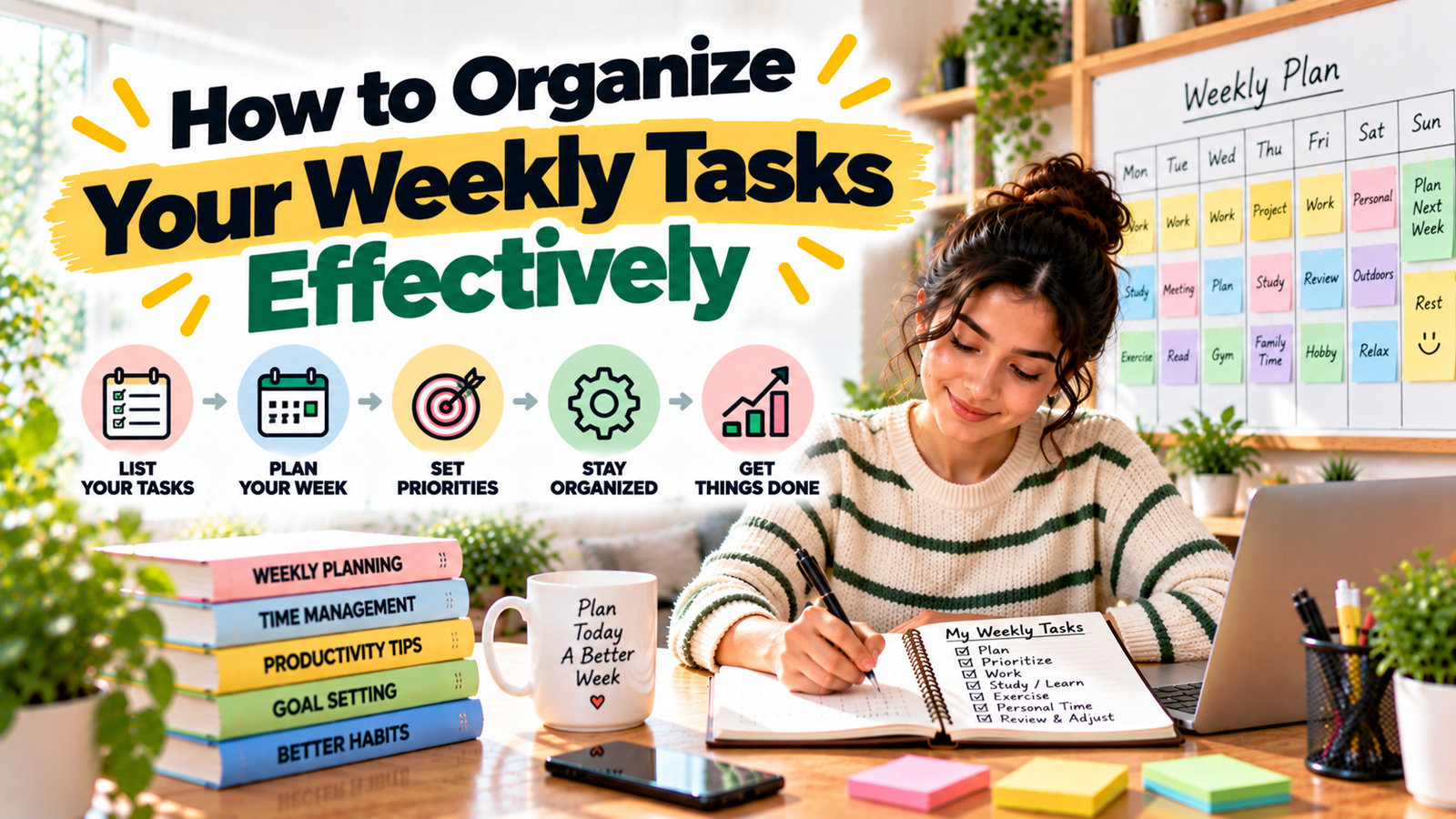
Introduction
Organizing weekly tasks effectively is one of the simplest ways to manage time, reduce stress, and improve productivity. Many people have several responsibilities to handle every week, including work, studies, household activities, personal goals, and family commitments. When these responsibilities are not organized properly, it becomes easy to forget important tasks, waste time, and feel overwhelmed.
In my opinion, a productive week does not depend on how many tasks we complete. It depends on how well we use our available time and how effectively we focus on the things that matter most. A simple weekly plan can help us understand our priorities, prepare for upcoming responsibilities, and make steady progress toward our goals.
You do not need expensive planning tools or a complicated schedule to organize your weekly tasks. A notebook, a calendar, or a basic digital task list can be enough to get started. The important thing is to create a system that fits your lifestyle and is easy to maintain.
In this article, I will explain how to organize your weekly tasks effectively using practical planning techniques, realistic goals, time management strategies, and simple daily habits.
Why Is Weekly Task Planning Important?
Weekly task planning helps you see your responsibilities before they become urgent. Instead of deciding what to do every morning, you can prepare a general plan in advance and begin your day with a clearer direction.
For example, if you have a work deadline on Thursday, planning your week allows you to divide the work across several days. You can collect information on Monday, complete the main work on Tuesday and Wednesday, and review everything before the deadline.
Without a plan, you might delay the project until Wednesday evening and feel unnecessary pressure.
Weekly planning also helps you balance different areas of life. You can make time for work, exercise, household responsibilities, personal development, and relaxation instead of allowing one activity to consume your entire schedule.
Another important benefit is that planning makes it easier to recognize when you have too much work. If your weekly schedule is already full, you can adjust your priorities before accepting additional responsibilities.
1. Start by Listing All Your Weekly Tasks
The first step in organizing your weekly tasks is to write down everything you need to accomplish. Before deciding when to complete each activity, collect all your responsibilities in one place.
Your list might include work assignments, study sessions, meetings, shopping, cleaning, appointments, exercise, and personal projects.
At this stage, do not worry too much about the order of the tasks. Focus on creating a clear overview of your responsibilities.
Writing everything down reduces the need to remember every detail throughout the day. It also helps you identify tasks that you may have forgotten or postponed.
For example, if you are managing a website, your weekly task list might include writing articles, checking website pages, preparing images, reviewing published content, and planning future topics.
Once these tasks are written down, you can decide which activities need immediate attention and which can be scheduled for later.
Try to keep your master list in one main location. If your tasks are scattered across different notebooks, messages, and applications, it can become difficult to maintain an accurate picture of your workload.
2. Identify Your Most Important Priorities
Not every task deserves the same amount of attention. Some activities have strict deadlines, while others are useful but can wait.
After creating your weekly task list, identify the responsibilities that will have the greatest impact on your goals.
One simple method is to divide tasks into three groups.
High priority tasks: These include urgent deadlines, important assignments, appointments, and responsibilities that could create problems if delayed.
Medium priority tasks: These are meaningful activities that support your goals but do not require immediate completion.
Low priority tasks: These include optional activities, minor improvements, and tasks that can be postponed without serious consequences.
For example, completing a report due on Tuesday should generally take priority over reorganizing files that do not affect your current work.
I believe prioritization is essential because being busy does not always mean being productive. You can spend an entire day completing minor activities while making little progress on your most important goals.
Review your priorities at the beginning of each week. This will help you direct your attention toward the tasks that deserve it most.
3. Set Realistic Weekly Goals
Once you know your priorities, decide what you realistically want to achieve by the end of the week.
Weekly goals provide direction and help you measure progress. However, these goals should reflect your actual schedule, energy, and responsibilities.
For example, instead of deciding to complete ten major projects in one week, identify two or three important outcomes that you can reasonably accomplish.
Your goals might include completing a work assignment, finishing three study chapters, or publishing two well researched articles.
Make each goal specific enough that you can determine whether it has been completed.
It is also helpful to divide large goals into smaller tasks. If your goal is to prepare a detailed report, you can schedule research, outlining, writing, editing, and final review as separate activities.
This makes the workload easier to understand and reduces the temptation to postpone a project because it appears too complicated.
Remember that a weekly plan should help you make progress, not create unrealistic expectations. Leave room for unexpected responsibilities and changes in your schedule.
4. Assign Tasks to Specific Days
After setting your weekly priorities, decide which days are most suitable for each activity.
Assigning tasks to specific days gives your plan structure and helps prevent important work from being delayed until the end of the week.
For example, you might use Monday to review priorities and begin important projects, Tuesday for focused work, Wednesday for meetings and follow up activities, Thursday for completing major assignments, and Friday for reviewing progress.
This is only an example. Your schedule should depend on your work hours, study timetable, family responsibilities, and personal preferences.
When assigning tasks, consider their deadlines and the amount of concentration they require.
If you have a demanding assignment, schedule it during a period when you can usually focus well. If a task is simple and does not require much attention, you may be able to complete it between other responsibilities.
Avoid placing too many major tasks on a single day. Spreading your workload across the week can make your schedule more manageable.
5. Use Time Blocking to Manage Your Schedule
Time blocking is a planning technique in which you reserve specific periods for particular activities.
Instead of writing only that you need to study or complete a project, decide when you will work on it.
For example, you might reserve 9:00 AM to 10:00 AM for focused work, 10:30 AM to 11:00 AM for emails, and 4:00 PM to 4:30 PM for exercise.
Time blocking helps you understand how your available hours will be used. It also makes it easier to recognize when your schedule contains more work than you can realistically complete.
However, do not fill every minute with a planned activity. Allow some flexibility for breaks, unexpected calls, and tasks that take longer than expected.
If you are new to time blocking, start with your most important responsibilities. You can gradually add smaller activities as you become more comfortable with the method.
The goal is to create a useful structure rather than a rigid timetable that becomes difficult to follow.
6. Break Large Tasks Into Smaller Steps
Large projects can be difficult to manage when they remain on your weekly task list as single items.
For example, writing a long article involves choosing the topic, researching information, preparing headings, writing the content, editing the draft, and publishing the finished article.
Writing only “complete article” on your list may not provide enough direction about where to begin.
Instead, divide the project into smaller actions and assign them to different days.
You might research the topic on Monday, prepare the outline on Tuesday, write the first draft on Wednesday, and edit and publish the article on Thursday.
This approach makes the project easier to manage and allows you to track your progress more accurately.
The same method works for studying, preparing presentations, organizing your home, and completing work assignments.
Whenever a task feels too large to start, ask yourself what the next specific action should be. Once you identify that action, add it to your schedule.
7. Choose a Reliable Planning Tool
You do not need a complicated application to organize weekly tasks. The best planning tool is one that you can use consistently without spending too much time maintaining it.
A paper notebook works well if you prefer writing tasks by hand. A calendar can help you manage appointments and deadlines. A digital task list may be more convenient if you regularly use your phone or computer.
You can also combine a weekly calendar with a simple checklist.
Use the calendar for tasks that must happen at a particular time, such as meetings and appointments. Use the checklist for activities that need to be completed during the week but have more flexible timing.
For example, you might schedule a meeting for Wednesday at 11:00 AM while keeping tasks such as organizing documents or reviewing study notes on a separate list.
Try to avoid switching between too many planning tools. Keeping your information organized in one or two places makes it easier to review and update your schedule.
8. Build a Consistent Daily Planning Habit
Weekly planning provides the overall direction, but daily planning helps you turn that plan into action.
At the beginning of each day, spend a few minutes reviewing your scheduled tasks. Choose the most important activities and identify what needs to be completed first.
You can begin by selecting three main priorities for the day. This gives you a manageable target without requiring you to finish every item on your weekly list immediately.
For example, your priorities might include completing a work assignment, attending an appointment, and spending 30 minutes studying.
If you finish these tasks early, you can move on to other activities from your list.
At the end of the day, review what you accomplished and move unfinished tasks to another suitable time if necessary.
Do not automatically carry every incomplete task into the next day without considering its importance. Some tasks may need to be rescheduled, simplified, delegated, or removed from your list.
A short daily review helps keep your weekly plan realistic and up to date.
9. Avoid Overloading Your Weekly Schedule
One common planning mistake is assuming that every available hour should be used for productive work.
In reality, your week also needs time for rest, meals, personal responsibilities, travel, and unexpected events.
If you schedule too many activities, even a small interruption can disrupt your entire plan.
To avoid this problem, estimate how long each task will take and compare the total workload with the time you actually have available.
For example, if a project requires three hours, do not schedule it during a period when you have only one free hour.
It is also helpful to leave some unplanned time in your week. This flexibility allows you to handle urgent responsibilities without abandoning everything else on your schedule.
If your task list becomes too long, review your priorities and focus on the activities that matter most.
You may also be able to postpone optional tasks or divide a large project across several weeks.
A realistic weekly schedule is usually more useful than an ambitious plan that you cannot maintain.
10. Reduce Distractions During Important Tasks
Even a well organized schedule will not be very effective if distractions constantly interrupt your work.
Mobile notifications, social media, unnecessary browsing, and frequent interruptions can make simple tasks take longer than expected.
Before beginning an important activity, prepare your workspace and remove avoidable distractions.
For example, silence nonessential notifications, keep relevant documents nearby, and close unrelated browser tabs.
You can also work in focused sessions of 25 or 30 minutes, followed by a short break. Adjust the length according to the task and your concentration level.
If you need to check messages throughout the day, consider setting specific periods for doing so instead of checking them repeatedly.
It is not always possible to work without interruptions, especially when you have family or workplace responsibilities. In those situations, try to schedule demanding tasks during the periods when interruptions are less likely.
Protecting your attention helps you complete scheduled work more efficiently and leaves more time for other priorities.
11. Review Your Progress at the End of the Week
A weekly review helps you understand whether your planning system is working.
At the end of the week, look at your completed tasks, unfinished responsibilities, and progress toward your goals.
Ask yourself a few practical questions. Which activities went according to plan? Which tasks took longer than expected? What caused unnecessary delays? What changes could make next week easier?
For example, you may discover that you regularly underestimate the time required to write an article. Next week, you can reserve additional time for research and editing.
You may also find that your mornings are more productive than your evenings. If your responsibilities allow it, you can schedule demanding work earlier in the day.
Use the review to learn from your experience rather than criticize yourself for every unfinished task.
Some weeks will be busier than others, and unexpected events may change your priorities. What matters is using the information to improve your next plan.
Example of a Simple Weekly Task Schedule
Here is an example of how you can organize your weekly tasks without creating an overly complicated routine.
Monday: Review weekly goals, prepare your task list, and begin the most important project.
Tuesday: Continue focused work and complete important assignments with approaching deadlines.
Wednesday: Handle meetings, appointments, follow up activities, and ongoing projects.
Thursday: Complete major tasks and review any work that must be submitted soon.
Friday: Finish remaining priorities, organize documents, and review your weekly progress.
Saturday: Handle household responsibilities, personal projects, shopping, or other activities that fit your schedule.
Sunday: Rest, spend time with family, and prepare a simple plan for the upcoming week.
This schedule is flexible rather than compulsory. You can change the days according to your job, education, family responsibilities, and personal needs.
The purpose is to give important activities a place in your week while maintaining enough flexibility to handle changes.
Conclusion
Learning how to organize your weekly tasks effectively can help you manage responsibilities, improve productivity, and reduce the stress that comes from an unplanned schedule.
The process begins with writing down your tasks, identifying your priorities, setting realistic goals, and assigning activities to suitable days. Using time blocking, breaking large projects into smaller steps, and reviewing your progress can make your planning system even more effective.
In my opinion, the most important part of weekly task planning is consistency. You do not need to create a perfect schedule every week. You simply need a practical system that helps you understand what matters, use your time wisely, and adjust when circumstances change.
Start with a short planning session before your next week begins. Write down your responsibilities, choose your main priorities, and decide when you will work on them. As you learn from your experience, you can improve your routine and develop a planning method that works for your everyday life.